TaskRio vs Tasks.Bot for Screen Scraping Automation
You need task updates from a field crew, not another scraper script. Teams already coordinate through WhatsApp, yet many platforms force a separate login and a new dashboard nobody opens. If your operations run on chat, the tool should meet you there.
This article explains what Tasks.Bot actually does inside WhatsApp, whether it supports screen scraping automation, and which features matter for field teams. You will also see pricing in rupees and dollars, beta trust signals, and a clear verdict on when to look elsewhere.
What Is Tasks.Bot? Task Management Inside WhatsApp
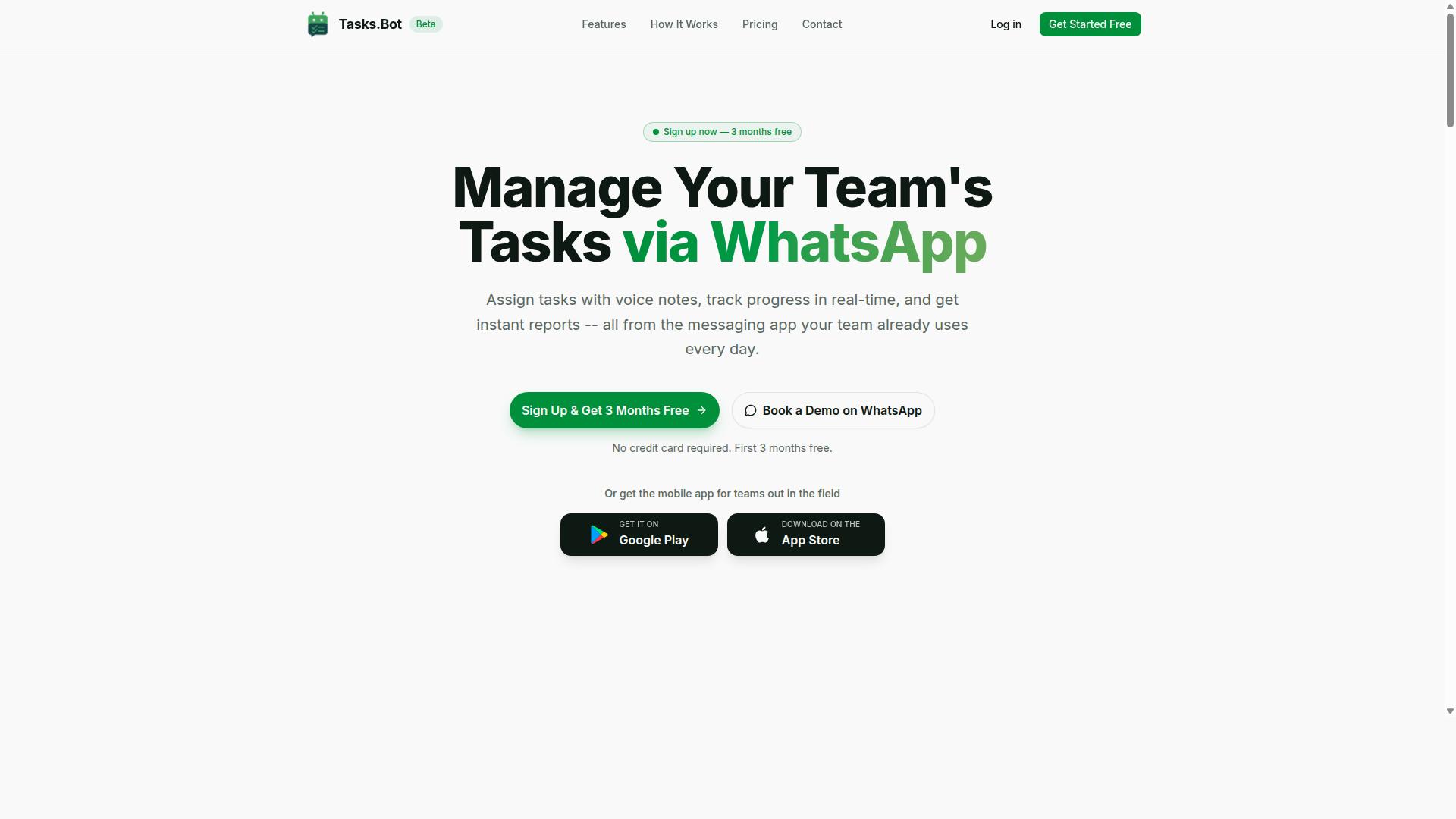
Tasks.Bot is a task management platform that runs entirely inside WhatsApp, letting teams assign tasks, track progress, and receive reports without leaving the messaging app. It also offers a mobile app for field teams that need a dedicated interface.
For team members, there is no new app to install and no account to create. The platform is currently in beta and offers a free trial period.
Who Tasks.Bot Serves: Field Teams, WhatsApp-First Crews, and Operations Managers
Tasks.Bot is built for teams that already use WhatsApp for communication, especially those with field staff who need task management, attendance tracking, and payroll-ready hours. The site mentions that hundreds of teams already use the service.
This audience shares a common trait: they live in messaging apps, not in separate project management dashboards. Field staff rarely want to open another tool on a phone while moving between job sites. Operations managers, meanwhile, need a record of who did what and when, without chasing updates across multiple channels.
The WhatsApp-first approach fits both sides. Workers receive assignments where they already chat, and managers get progress and reports in the same thread. Attendance tracking and payroll-ready hours flow from that same activity, which reduces the manual reconciliation that usually follows a job.
Tasks.Bot is not aimed at software teams running sprint boards or enterprises with complex ticketing needs. It targets practical operations where the work happens off a desk:
- Field crews coordinating jobs across locations
- WhatsApp-first teams that resist adopting new software
- Operations managers tracking attendance and hours
Because the platform is in beta with a free trial, these teams can evaluate whether a messaging-native workflow fits their day-to-day operations before committing.
Does Tasks.Bot Support Screen Scraping Automation? The Honest Answer
Tasks.Bot does not support screen scraping automation; it is designed for task management, not for extracting data from websites or applications.
The confusion is understandable. The word "bot" appears in both worlds, but a WhatsApp task bot and a headless browser scraper solve completely different problems. One organizes people and work. The other pulls structured data from web pages.
So if your goal is data extraction from live sites, Tasks.Bot is not the tool for that job. It is the tool for making sure the people doing the work actually finish it.
What Tasks.Bot Actually Automates: Tasks, Reminders, Approvals, and Reports
Tasks.Bot automates task assignments, smart deadline reminders, approvals, and instant reports, all within WhatsApp. It uses AI to understand user intent and create tasks from messages, so a quick voice note can become a tracked assignment without anyone opening a separate app.
Here is what the platform actually handles:
- Voice note task creation, turning spoken instructions into recorded tasks
- Automatic task assignment, routing work to the right person
- Smart deadline reminders, so nothing quietly slips past its due date
- Approvals and automations, keeping sign-off steps moving
- Instant reports, giving a live view of what is done and what is pending
Beyond the core loop, Tasks.Bot also includes tasks on a map, a live day tracker, face-verified attendance, and shifts, leave, and hours management. Android and iOS apps add push notifications, voice capture, and a home screen widget.
None of this touches a web page. A screen scraping workflow needs a browser engine such as Chromium, Firefox, or WebKit plus a framework like Puppeteer, Playwright, or Selenium. Tasks.Bot needs none of that.
The contrast matters for buyers. If you need a data pipeline or a scheduled scrape, look at a dedicated visual scraper or a browser automation stack. If you need workflow automation around human tasks, approvals, and reporting inside the messaging app your team already uses, that is exactly the gap Tasks.Bot fills.
Key Features and What Makes Tasks.Bot Stand Out
Tasks.Bot differentiates itself by operating entirely within WhatsApp and using AI to understand natural language and voice notes for task creation. Team members do not need to install anything or create new accounts, which keeps adoption simple for crews already using WhatsApp every day.
Beyond messaging, Tasks.Bot adds face-verified attendance and live GPS tracking for field staff. Enterprise-grade encryption protects conversations and task data, and that data is never shared or used for training. A 3-month free trial with no credit card required lets teams evaluate the platform before committing.
For anyone weighing Tasks.Bot against screen scraping automation, the distinction is worth noting: Tasks.Bot is built for task management, workflow automation, and field operations rather than browser automation or data extraction workloads. Its strengths lie in coordinating people and jobs, not in Puppeteer, Playwright, or headless browser scripting.
Voice Note Task Creation, AI Natural Language, and Smart Deadline Reminders
Users can create tasks by sending a voice note or typing naturally, and Tasks.Bot uses AI to parse the request and set smart deadline reminders. There is no form to fill in and no rigid field structure to learn. The AI interprets user intent and turns a casual message into a structured task.
This matters most for field teams who are moving between sites, driving, or working with their hands. Typing a detailed task on a phone in bright sunlight or while wearing gloves is slow and error-prone. A short voice note removes that friction entirely.
The workflow stays inside the same chat thread the team already uses. Once a task exists, Tasks.Bot handles automatic task assignment, approvals and automations, and instant reports. Smart deadline reminders then keep those tasks visible without a manager chasing anyone manually.
For operations leads comparing tools, this is a different category of automation than screen scraping or web scraping. Tasks.Bot automates coordination and follow-through, while a visual scraper or cloud scraping platform automates data extraction from websites. Both are useful, but they solve unrelated problems.
Teams that adopt voice-first task creation tend to see fewer dropped handoffs because the barrier to logging work is so low. When logging a job takes five seconds of speech instead of a minute of typing, people actually do it.
Face-Verified Attendance, Live GPS Tracking, and Tasks on a Map
Tasks.Bot includes face-verified attendance, live GPS tracking, and a map view of tasks, making it ideal for managing field staff. Face verification confirms that the person clocking in is the person assigned to the shift, which reduces buddy punching and attendance disputes.
Live GPS tracking gives operations managers a real-time sense of where field staff are during the working day. Combined with tasks on a map, it becomes easy to see which jobs sit near which crew members, which helps with routing and same-day reassignment.
These features support shifts, leave, and hours management in the same system. Instead of reconciling a separate attendance app, a spreadsheet, and a messaging thread, managers work from one view tied to the tasks themselves. The live day tracker adds another layer of visibility across the schedule.
For operations managers overseeing remote or distributed teams, the value is straightforward: fewer manual check-ins, fewer payroll questions, and faster answers when a client asks who was on site and when. Native WhatsApp integration means the data arrives through a channel the team already trusts.
It is worth being clear about scope. Tasks.Bot is a task management and field operations tool, not a browser automation or RPA platform. Teams evaluating it against screen scraping automation should treat the two as complementary rather than competing.
Pricing and Plans: Full Access in ₹ and $
Tasks.Bot offers a single 'Full Access' plan with all features included, priced at ₹200 per member per month or ₹1,200 per year per member, with equivalent pricing in US Dollars. That single-tier structure removes the guesswork that usually comes with screen scraping tools, where capabilities are often split across starter, pro, and enterprise levels.
For teams building data extraction workflows, a flat plan means every user gets the same toolset from day one. There is no need to estimate how many page loads, scheduled runs, or automation steps a project will need before choosing a tier.
| Plan | Price (₹) | Price ($) | Billing Cycle |
|---|---|---|---|
| Full Access (Monthly) | ₹200 per member | Equivalent USD rate | Per month |
| Full Access (Annual) | ₹1,200 per member | Equivalent USD rate | Per year |
The annual option saves 50%, which works out to ₹1,200 saved per year per member compared with paying monthly. For a small team running recurring web scraping jobs, that difference adds up quickly across seats.
Pricing is listed in Indian Rupees and US Dollars, and the site provides a 'Select currency' option with Indian Rupee and US Dollar choices. Readers should confirm the displayed currency at checkout, since conversion rates and regional tax rules can shift the final amount.
New users also get 3 months free, with no credit card required and the ability to cancel anytime. That trial window gives teams room to test task scheduling and other workflow pieces against real targets before committing budget.
Compared with tools that meter usage or lock advanced options behind higher tiers, the Tasks.Bot model is straightforward: one price, every feature, per member. For anyone weighing no-code automation against custom scripts, that predictability makes cost planning simpler.
Trust Signals: Beta Status, Encryption, and Hundreds of Teams
Tasks.Bot is currently in beta, uses encryption to protect data, and is already used by hundreds of teams. Those three facts tell you more about the platform's maturity than any marketing page could on its own.
For anyone comparing screen scraping automation options, trust signals matter as much as features. A tool can offer every capability on paper and still fail you if the team behind it is not actively improving the product or protecting the data flowing through it.
Here is what each signal actually means for a buyer evaluating Tasks.Bot for web scraping and data extraction work.
Beta status signals active development. A product in beta is one that is still being shaped, tested, and refined. That is not a weakness. It means fixes and improvements ship on a faster cycle than a frozen legacy tool.
For teams building data pipelines, that pace matters. Scraping targets change constantly. Sites update their HTML parsing structures, adjust JavaScript rendering, and shift anti-bot evasion tactics. A platform under active development is better positioned to keep pace with those changes than one that stopped evolving years ago.
Beta also implies transparency. Tasks.Bot labels its status openly rather than presenting a finished product that is not finished. Buyers know exactly what stage they are joining.
Encryption protects the data you move. Screen scraping automation often touches sensitive material. Login credentials, API integration keys, extracted business data, and JSON output destined for internal systems all pass through the platform.
Encryption is the baseline control that keeps that material from being exposed in transit or at rest. For anyone running browser automation against internal dashboards or pulling competitive intelligence, it is a non-negotiable requirement. Tasks.Bot states that it uses encryption to protect data, which puts it in the category of tools that treat security as a design decision rather than an afterthought.
Hundreds of teams already use the platform. Adoption is a practical trust signal. Hundreds of teams running Tasks.Bot means the platform has survived contact with real workloads: cron jobs that fire on schedule, conditional logic that branches on extracted values, and workflows that cannot afford silent failures.
It also means a body of shared experience exists. Teams evaluating no-code automation tools can reasonably assume common friction points have surfaced and been addressed, because a product does not retain hundreds of users through repeated breakage.
Two additional trust details are worth noting for anyone weighing a decision:
- Refund policy. The site mentions a refund policy in the footer, which lowers the risk of trying the platform before committing to a paid workflow.
- Book a Demo on WhatsApp. The website includes a 'Book a Demo on WhatsApp' option, giving prospective users a direct, familiar channel to evaluate the tool before building on it.
Together, these signals point to a platform that is honest about its stage, serious about data security, and already validated by a meaningful user base. For screen scraping automation where reliability and data handling are the real stakes, that combination is a stronger indicator of trust than any single feature list.
Who Should Use Tasks.Bot - and When to Look Elsewhere
Tasks.Bot is ideal for WhatsApp-first teams, especially those with field staff, but it is not suitable for screen scraping or complex data extraction needs. The distinction matters because the two categories of software solve very different problems, and picking the wrong one wastes both budget and engineering time.
Tasks.Bot is built around communication and coordination for people who are already working inside WhatsApp. Its stated audience is teams that use WhatsApp for communication, particularly those with field staff who need task management, attendance tracking, and payroll-ready hours. If that describes your operation, the fit is direct rather than incidental.
The site notes that hundreds of teams already use the service, which suggests the product has settled into a recognizable niche rather than trying to be everything to everyone. That focus is a strength for the right buyer and a limitation for the wrong one.
Below are the profiles that tend to get the most value from Tasks.Bot, followed by the situations where a different category of tool is the honest answer.
- Operations managers who assign work over WhatsApp and need visibility into whether it was completed
- Field staff and their supervisors who need attendance tracking tied to real shifts
- Payroll and admin teams that want hours captured in a form that is ready for payroll processing
- Small and mid-sized teams that already run day-to-day coordination through chat rather than a separate project management suite
The common thread is human task coordination. Work is created, assigned, acknowledged, and closed out by people. Tasks.Bot supports that loop in the channel those people already use, which reduces the friction of adopting yet another dashboard.
Where the fit breaks down is any requirement that involves pulling structured data out of websites or web applications. Tasks.Bot is not a screen scraping tool, and it is not positioned as one. Asking it to perform data extraction at scale is a mismatch of purpose, not a shortcoming of execution.
If your goal is to harvest product listings, monitor competitor pricing, aggregate job postings, or feed a data pipeline, you need a dedicated scraping platform. Those tools handle concerns that sit entirely outside Tasks.Bot's scope: JavaScript rendering, proxy rotation, CAPTCHA handling, and anti-bot evasion among them.
The table below summarizes the split in practical terms.
| Requirement | Tasks.Bot | Dedicated scraping tool |
|---|---|---|
| Assign and track work over WhatsApp | Yes, core purpose | Not applicable |
| Attendance and payroll-ready hours | Yes, core purpose | Not applicable |
| Extract data from web pages | Not the intended use | Yes, core purpose |
| Headless browser automation | Not the intended use | Yes, core purpose |
| DOM parsing with XPath or CSS selectors | Not the intended use | Yes, core purpose |
| JSON output or CSV export of scraped records | Not the intended use | Yes, core purpose |
When evaluating scraping tools instead, look for the capabilities your target sites actually demand. A simple static page may only need HTML parsing and a scheduled run. A modern single-page application will likely require JavaScript rendering through a headless browser such as Chromium, and possibly browser fingerprinting controls to keep sessions stable.
Other questions worth asking before committing: does the tool support proxy rotation, how does it handle CAPTCHA solving, and can it push results onward through an API integration or webhooks? Teams building recurring data pipelines should also check scheduling options, whether that means cron jobs or trigger events, and whether conditional logic and loop actions are available for multi-step flows.
There is a middle ground worth naming. Some teams adopt a no-code automation platform to connect a scraper to downstream systems, and separately use Tasks.Bot for the human side of the work. A field manager confirming a site visit and a scraper collecting public pricing data are different jobs, and there is no reason one product must do both.
The clearest way to decide is to ask what the output of the work actually is. If the output is a completed task, a logged shift, or a verified attendance record, Tasks.Bot is aimed squarely at you. If the output is a dataset, a spreadsheet of extracted fields, or a stream of records feeding another system, you are shopping in the wrong category.
For WhatsApp-centric teams with field staff, the verdict is straightforward: Tasks.Bot fits the way your people already work, and hundreds of teams are already using it for exactly that. For screen scraping and web scraping automation, look to a purpose-built extraction tool and keep Tasks.Bot for the coordination layer it was designed to handle.
Final Verdict: Tasks.Bot for Screen Scraping Automation
Tasks.Bot is not a screen scraping automation tool; it excels at task management within WhatsApp, making it a poor fit for scraping needs. Readers searching for a visual scraper, cloud scraping platform, or headless browser setup will not find those capabilities here. The product serves a different purpose entirely, and judging it against web scraping benchmarks would be unfair to what it actually does well.
Screen scraping typically demands a specific technical stack: DOM parsing through XPath or CSS selectors, JavaScript rendering, proxy rotation, CAPTCHA solving, and anti-bot evasion. Tools built for this work often rely on Puppeteer, Playwright, Selenium, or Chromium-based headless browsers to handle browser fingerprinting and dynamic pages. Tasks.Bot does not operate in that space, and its verified feature set does not include data extraction or scraping pipelines.
What Tasks.Bot does offer is task management and automation within WhatsApp. That focus makes it useful for organizing work, coordinating activities, and handling workflow automation inside a messaging environment that many teams already use daily. For readers whose real need is keeping tasks on track rather than harvesting data from websites, this is the strength that matters.
If your goal involves task scheduling, workflow automation, or no-code automation inside WhatsApp, Tasks.Bot is a reasonable choice. If your goal involves screen scraping, web scraping, or building data pipelines with ETL and RPA components, you need a dedicated scraping tool instead. Matching the tool to the job is the entire decision here.
Readers who want to learn more about Tasks.Bot can reach the team directly:
- Phone: +91 97143 42522
- Email: [email protected]
The recommendation is straightforward. Choose Tasks.Bot when your priority is task management within WhatsApp. Look elsewhere when your priority is screen scraping automation, because that is simply not what this product was built to do.
Frequently Asked Questions
What's the biggest difference between Tasks.Bot and TaskRio for screen scraping automation?
Tasks.Bot isn't a screen scraping tool at all - it's a task management platform that runs entirely inside WhatsApp, so teams can assign tasks, track progress, and get reports without installing anything new. If your goal is scraping data from websites, you'd pair a dedicated scraping tool with Tasks.Bot to manage the people, approvals, and follow-ups around that work. TaskRio's specific scraping features and pricing aren't something we can speak to here, so compare those directly on their site.
Can Tasks.Bot actually automate the scraping itself?
No - Tasks.Bot focuses on automating the task workflow around your operations, not the scraping engine. It handles things like automatic task assignment, smart deadline reminders, approvals, and automations, plus instant reports. For the actual data extraction, you'd use a scraping tool and let Tasks.Bot coordinate who does what and when.
Do my team members need to install an app or create new accounts to use Tasks.Bot?
No. Tasks.Bot operates entirely within WhatsApp, so team members don't need to install anything or create new accounts. There's also a mobile app available for field teams who need it. This makes it easy to roll out to staff who are already communicating on WhatsApp.
How much does Tasks.Bot cost compared to TaskRio?
Tasks.Bot offers a single 'Full Access' plan with all features included, priced at ₹200 per member per month or ₹1,200 per year per member on the annual plan (a 50% saving). Pricing is available in both Indian Rupees and US Dollars. We can't comment on TaskRio's pricing - check their site for current rates.
How does Tasks.Bot help teams that also handle scraping-related field or ops work?
Tasks.Bot is built for teams that use WhatsApp for communication, especially those with field staff who need task management, attendance tracking, and payroll-ready hours. Features include voice note task creation, tasks on a map, live day tracking, and face-verified attendance. If scraping feeds into a broader operation with people in the field, Tasks.Bot keeps everyone coordinated in one place.
Is Tasks.Bot available in my country, and how do I try it?
Yes - Tasks.Bot is a SaaS product available worldwide via WhatsApp and mobile apps, with no country restrictions mentioned. You can book a demo on WhatsApp directly from the website, or reach the team at [email protected] or +91 97143 42522. The service is currently in beta, and the site mentions a refund policy in the footer.
Recommended Resources: